by Naomi Zürcher | May 1, 2017 | Events
The University of Massachusetts Amherst, Department of Environmental Conservation, will present its next monthly UF webinar, entitled: “Selecting Tough Trees for Tough Urban Sites” on Thursday, May 4th at 5:00 PM, British Daylight Time and 6:00 PM for the rest of Europe. Additional information as well as registration procedures can be found at the following link:
http://www.urbanforestrytoday.org
by Naomi Zürcher | May 1, 2017 | Articles
This resource, a collaboration between i-Tree and Davey Institute, offers sustainable strategies for Urban Forest management.
http://www.itreetools.org/resources/content/Sustainable_Urban_Forest_Guide_14Nov2016.pdf
by Naomi Zürcher | Apr 16, 2017 | Articles
Noteworthy Requirements for Conifer and Hardwood Selection
Tree Shopping Guide – selecting quality in the nursery
Dear Colleagues:
Authored for a NYC Root Zone seminar entitled The Art of Woody Plant Selection, the two resources, noted above, were both developed as informative evaluation tools for landscape professionals who specify, inspect and tag woody plant material. They have been incorporated into the efuf.org library (under Media) as open source and can be accessed using the following links:
Tree Shopping Guide – selecting quality at the nursery
noteworthy requirements for conifer and hardwood selection
.Any suggestions, comments, etc are encouraged in order to expand the knowledge base.
by Naomi Zürcher | Apr 11, 2017 | Events
Exploring Urban Forestry’s Reduction of Health Care Expenditures. Please join the Yale Center for Business and the Environment (CBEY) for the next webinar of the 2016-2017 season of Nature’s Returns: Investing in Ecosystem Services.
Date: 12 April 2017
Time: 11:45 AM US Eastern Standard Times (16:45 GBT, 17:45 European continent)
To register, please use the following link:
https://yalesom.zoom.us/webinar/register/ba7a401cc051ff2ad746f627e8486654

by Rik De Vreese | Apr 11, 2017 | EFUF2017
The European Forum on Urban Forestry (EFUF) celebrates its 20th anniversary in the metropolis of Barcelona. The congress is open to researchers and professionals from Europe who are interested in reflecting on the urban forest fringe areas as spaces of opportunities that can be connected with and contribute to the territory. Twenty-first century cities have transformed their way of thinking: they have abandoned the idea of a central city with peripheral areas to now view the metropolis as a territorial mosaic of spaces, corridors and flows; a biophysical matrix where green infrastructure structures the territory to the detriment of the role of large transport infrastructure, and where spaces at the edge, on the limit, stop being administrative lines and begin to be seen as strategic spaces for ecology, leisure and production.
Under the title: “Urban Forest Boundaries. Within, between and beyond the city” we raise the importance of urban and peri-urban forests in building a sustainable and healthy landscape. We address issues such as ecological connectivity, compatibility of ecosystem services, biodiversity and disturbances, and the social aspects of forest management and planning those fringe areas in collaboration with the new culture of leisure. For all the above, we invite you to participate in our Congress, so that together we can address the latent problems in the contact and interaction between two realities destined to coexist: the city and open spaces.
More information at efuf2017.amb.cat
Register at http://formacio.ctfc.cat/inscripcions/efuf2017/inscripcio_en.php.

by Rik De Vreese | Apr 10, 2017 | EFUF2017, Survey
In anticipation of the European Forum on Urban Forestry 2017 in Barcelona, a core group of EFUFers have been discussing the state of Urban Forestry in Europe. It seems that Urban Forestry has been too underrepresented and disconnected in Europe. While the European Forum on Urban Forestry has hosted annual Forums for the past 19 years, that’s not enough to fill the void that the rest of the year leaves. Given the growing prominence of Urban Forestry in dealing with urban quality-of-life and climate change issues, the core group suggested to increase the presence of EFUF through a web-driven Urban Forest network, connecting the diverse disciplines that Urban Forest planning, design and management embraces.
In order to determine the direction that such a web presence should take and to find out more about the future role of EFUF, a short questionnaire was created to assess the ideas of professionals, who have an interest in Urban Forestry. The questionnaire was sent out in January and closed in March 2017. It was sent to 677 professionals from Africa, Asia, Australia, Europe, Northern and Southern America. The survey registered 276 visits (41%); 170 people responded completely (response-rate of 25%). 82% of the respondents are actually working in Europe.
- 38% of the respondents are female; 48% have a master degree. 45% are working in science and research. 25% of the respondents consider their professional experience as “early career”; 72% indicate “Urban Forestry” as their thematic focus. 44% of the respondents didn’t attend a forum yet; 61% intend to attend a future forum.
- 72% of the respondents think, the forum should be held annually. Sharing of knowledge and exchange between science and practice are considered very important. The respondents wish a sort of continuous organisation with a board, a secretary and an attractive web-presence. Working groups are also considered as very important.
- The benefits of a membership approach are considered in providing contacts and good examples and in early access to new knowledge. 60% are willing to pay a yearly fee for such an association of at least 40 Euro.
The survey showed a big interest in future forums as well in an EFUF-organisation that assures a continuous presence in the web and provides the members with information on a regular basis.
Building on the conclusions of the survey, the core group will present a roadmap at the Barcelona EFUF.
For further details: see the survey report.
by Naomi Zürcher | Apr 3, 2017 | Articles
An article in the Guardian (23 March 2017) has stated that the EC is poised to pass regulations that would ban the use of Neonicotinoid pesticides throughout Europe. The only exclusion would be greenhouse production.
As a Consulting Arborist, I have witnessed the devastating results of Neonic use on pollinator and beneficial insect populations. While many professionals who use these chemicals are conscientious and follow label instructions to the letter, Neonics are systemics that have a multi-month field life and so even being true to the label does not prevent pollinator mortality.
Here’s the link to the article, announcing this important step forward in increasing quality of life for all things that co-exist with us, within the Urban Forest and beyond:
https://www.theguardian.com/environment/2017/mar/23/europe-poised-for-total-ban-on-bee-harming-pesticides

by Naomi Zürcher | Feb 10, 2017 | Events
Plan-It Geo, a geospatial and software technology firm specializing in urban forestry, planning, and natural resources, has put together a Winter Webinar Series, consisting of 3 Webinars focused on computer-based Urban Forest assessment / management tools.
http://us7.campaign-archive1.com/?u=4ebc7b03f70907b7b0a743af2&id=de2f8280b4&e=73e0809391
Dates and Time:
• February 27 – 2 PM EST (NY), 7 PM UK, 8 PM Western Europe;
• March 1, 2 – 1 PM EST (NY), 6 PM UK, 7 PM Western Europe

by Rik De Vreese | Feb 10, 2017 | Events
The Online iTree Workshop will showcase community projects that have utilized i-Tree in analyzing and reporting information on the trees growing in these settings. Various i-Tree tools were used to tell stories, present information and help develop strategies in these communities. This online workshop will introduce these success stories to you during the web program.
i-Tree 2017 is a state-of-the-art, peer-reviewed software suite from the USDA Forest Service that provides urban forestry analysis and benefits assessment tools. The i-Tree Tools help communities of all sizes to strengthen their urban forest management and advocacy efforts by quantifying the structure of community trees and the environmental services that trees provide.
Time: 1 pm Eastern Standard Time (New York) – 7 pm Western Europe, 6 pm UK
Register here: link
More information on iTree: itreetools.org.
![Webinar 9 Feb – Urban Soils in the Age of Green Infrastructure Stormwater Management]()
by Naomi Zürcher | Feb 3, 2017 | Events
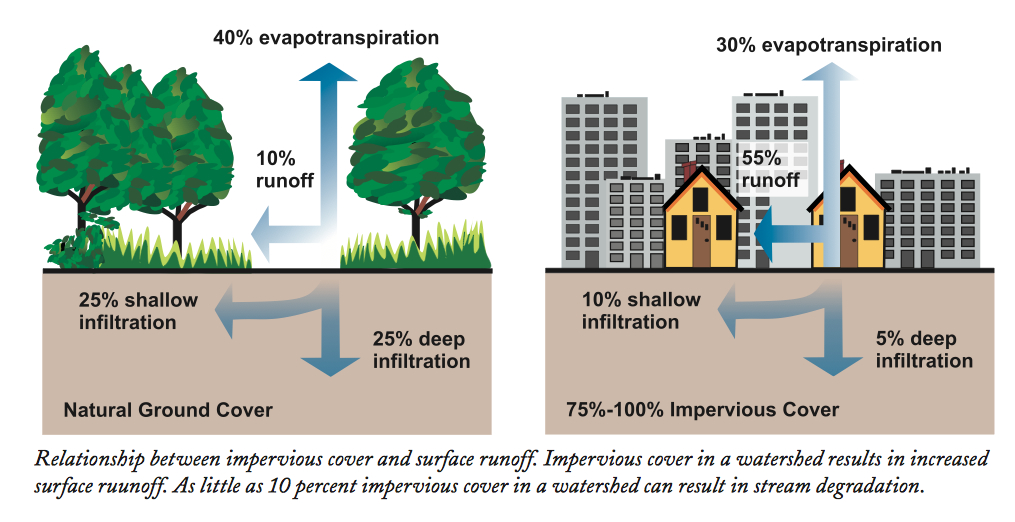
US Dept. of Environmental Protection (2003). Protecting Water Quality from Urban Runoff –
https://www3.epa.gov/npdes/pubs/nps_urban-facts_final.pdf
On Thursday, the 9th of February, at Noon (US Eastern Standard Time – +5 hours for the UK and + 6 hours for the European Continent), ‘Urban Forestry Today’ will present “Underfoot and Underappreciated: Urban Soils in the Age of Green Infrastructure Stormwater Management”. The host webcast speaker, Dr. Susan Day, Virginia Tech, is an Associate Professor with the Department of Forest Resources and Environmental Conservation.
This webcast will focus on a better understanding of how the soil environment impacts and affects urban tree longevity, performance and key environmental benefits associated with the urban forest, including stormwater management. Dr. Day will also discuss the use of engineered solutions (structural soils, suspended pavement), as well as the effects of soil compaction and remediation measures.
Dr. Day has focused her teaching and research on a variety of urban forestry issues with a particular emphasis on land development and urban design issues and how root / soil interactions affect the contribution of trees to urban ecosystems.
For those who cannot attend live in-person, the webcast will be archived in the ‘videos’ section at www.urbanforestrytoday.org
Author: Naomi Zurcher


